
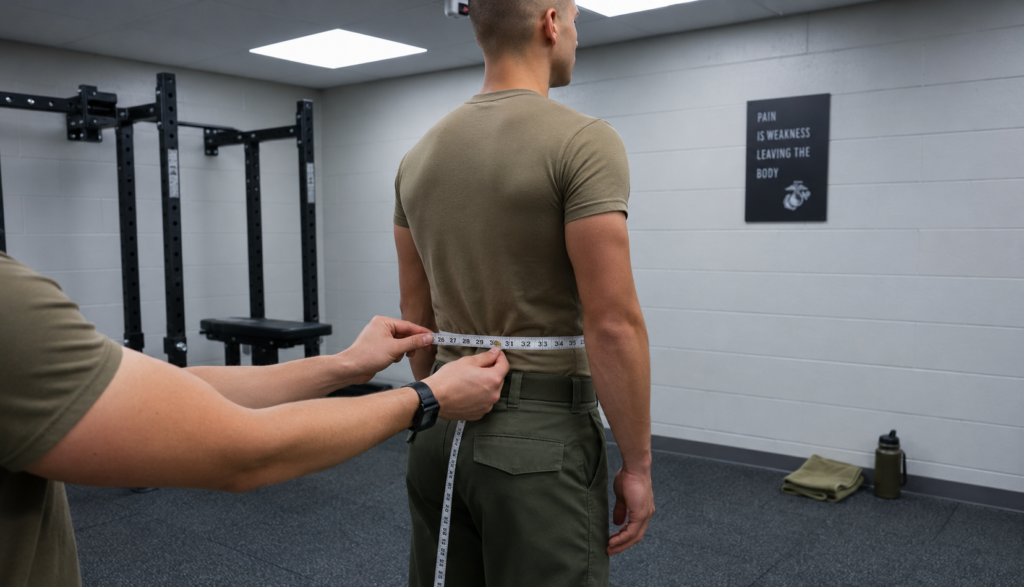
The U.S. Army does not use a body fat scale or skinfold calipers to estimate body composition. Instead, soldiers are measured with a simple tape measure, and the resulting circumference numbers are plugged into a fixed formula. This is often called the Army tape test, and it is part of the Army Body Composition Program (ACP), which works alongside height and weight standards and the Army Combat Fitness Test.
Understanding how this body fat calculation works is useful even outside a military context. It is a fast, low-cost, equipment-free way to estimate body fat percentage using nothing but a measuring tape, and the same circumference-based logic is used in similar civilian calculators.
What the Army Tape Test Actually Measures
The tape test estimates body fat percentage using circumference measurements at specific sites on the body. It does not measure fat directly the way a DEXA scan or hydrostatic weighing does. Instead, it uses a mathematical relationship between waist size, neck size, height, and (for women) hip size to estimate body fat percentage.
This approach is not as precise as lab-based body composition testing, but it is fast, repeatable, and requires no specialized equipment beyond a tape measure. That tradeoff — speed and accessibility over lab-grade accuracy — is exactly why the military adopted it for large-scale, routine measurement.
Why the Army Uses Circumference Instead of Calipers
Skinfold calipers require training to use consistently, and results vary a lot between different testers. Circumference measurements are more standardized: two different people measuring the same soldier with a tape measure will usually get very similar numbers. For an organization measuring hundreds of thousands of people, consistency matters more than lab-level precision.
The Sites Used in the Measurement
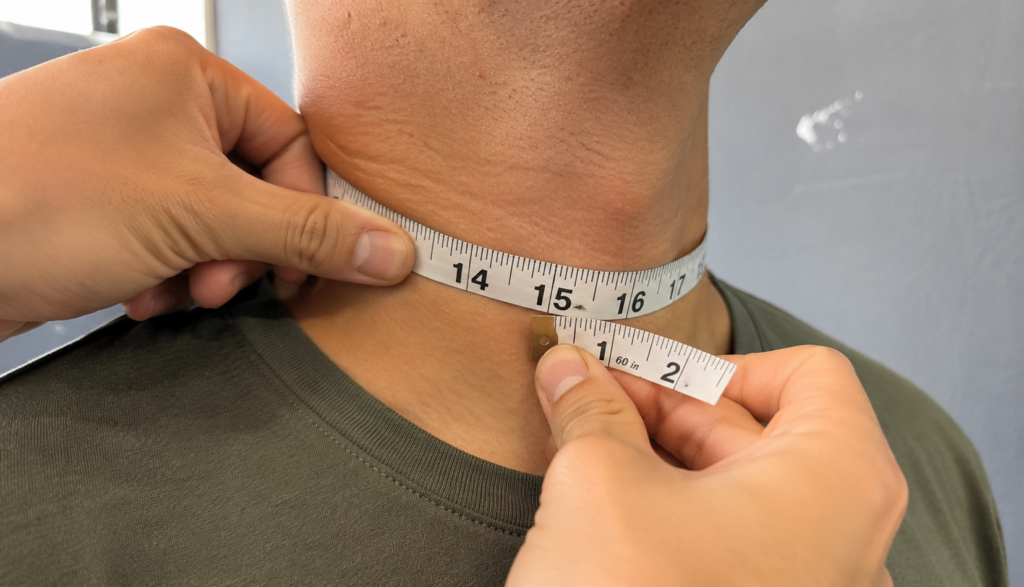
The exact sites depend on gender, since men and women tend to store fat differently and the formula accounts for that.
Male Measurement Sites
- Neck: measured just below the larynx, tape angled slightly downward at the front
- Waist (abdomen): measured at the navel, not the narrowest point of the torso
Female Measurement Sites
- Neck: measured just below the larynx, same technique as male measurement
- Waist: measured at the point of minimal abdominal circumference, not necessarily at the navel
- Hips: measured at the widest point around the buttocks
Height is also recorded for both genders, since it is part of the formula. Each site is typically measured three times and averaged, which reduces the impact of a single inconsistent reading.
How the Formula Calculates Body Fat Percentage
The Army uses a version of the U.S. Navy circumference method, adapted into equations published in Army Regulation 600-9. The formulas use the natural logarithm of circumference measurements combined with height, and they differ by gender because fat distribution patterns differ by gender.
For men, the formula relies on waist circumference minus neck circumference, factored against height. For women, it also factors in hip circumference, since female body fat distribution typically includes the hip region more heavily than male body fat distribution does.
Because the math involves logarithms rather than simple subtraction, the relationship between circumference and body fat percentage is not linear. A small change in waist measurement can shift the estimated percentage more at some baseline sizes than at others. This is one reason two people with similar waist sizes but different heights can land on different estimated percentages.
Why Height Matters in the Calculation
Height is included because circumference alone does not account for frame size. A taller person and a shorter person can have identical waist measurements but very different proportions relative to their overall frame, so the formula adjusts for that using height as a scaling factor.
Army Body Fat Standards by Age and Gender
The Army sets maximum allowable body fat percentage by age group and gender, and these standards are reviewed periodically. In general terms, allowable body fat percentage increases slightly with age, reflecting typical shifts in body composition over a lifespan, and male standards are set lower than female standards at every age bracket, consistent with typical physiological differences in essential fat between men and women.
| Age Group | Male Max Body Fat % | Female Max Body Fat % |
|---|---|---|
| 17–20 | Lower end of range | Lower end of range |
| 21–27 | Slightly higher | Slightly higher |
| 28–39 | Higher still | Higher still |
| 40+ | Highest allowable | Highest allowable |
Because exact percentage limits are updated through official Army Regulation revisions, soldiers should confirm current numbers through official Army sources rather than relying on older references, since standards have shifted over time as the regulation has been revised.
How This Interacts with the Height and Weight Table
The tape test is not usually the first step. Soldiers are first screened against Army height and weight standards. Only those who exceed the weight standard for their height move on to the circumference-based body fat calculation. This means the tape test functions as a secondary check, not a universal first measurement, for most service members.
Accuracy Compared to Other Body Fat Methods
Circumference-based estimation is less accurate than DEXA scans, hydrostatic weighing, or Bod Pod testing, all of which measure body composition more directly. Compared to skinfold caliper testing, tape measurements are generally considered more consistent between different testers, even if not necessarily more accurate against a true lab measurement.
The tradeoff is intentional. The Army needs a field-expedient method that can be administered quickly, without specialized equipment, by personnel who are not body composition specialists. For that use case, consistency and low cost outweigh the small accuracy gap compared to lab testing.
Common Sources of Measurement Error
Most inaccuracy in the tape test comes from technique, not the formula itself. Common issues include measuring at the wrong landmark, pulling the tape too tight or too loose, inconsistent posture between measurements, and not averaging multiple readings. Following the exact site instructions and taking the average of three measurements at each site reduces these errors significantly.
How to Calculate Your Own Estimate
To estimate body fat percentage using this method, you need accurate measurements of neck circumference, waist circumference, height, and, for women, hip circumference. These get entered into the gender-specific formula, or more practically, into an online calculator built around the same regulation, which removes the need to work through the logarithmic math by hand.
This is exactly the kind of calculation our body fat percentage calculator is built to handle. Instead of working through the logarithmic formula manually, you enter your circumference measurements and get an instant estimate based on the same method the Army uses.
Tips for Getting Consistent Measurements at Home
- Use a flexible, non-stretch tape measure, not a metal construction tape
- Measure in the morning, before eating, for consistency between sessions
- Keep the tape snug against skin but not compressing it
- Take each measurement three times and average the results
- Measure standing upright, without holding your breath or flexing your abdomen
How This Compares to Body Fat Percentage from BMI
Body mass index estimates body composition using only height and weight, without accounting for how weight is distributed. Two people with the same BMI can have very different waist and neck measurements, and therefore very different actual body fat percentages. This is part of why the Army moved to a circumference-based system rather than relying on BMI or weight-for-height tables alone — muscular soldiers were sometimes flagged as overweight by weight standards despite having low body fat, and the tape test gives them a way to demonstrate that.
When the Tape Test and BMI Disagree
A soldier with a high BMI due to muscle mass rather than fat can still pass the tape test even after failing the weight standard, since the circumference measurement reflects actual fat distribution rather than total body weight. This is the exact scenario the tape test was designed to catch — separating genuinely overweight individuals from those who are simply heavier due to muscle.
Key Takeaways
The Army body fat method uses neck, waist, and (for women) hip circumference along with height to estimate body fat percentage through a standardized formula. It trades some accuracy compared to lab-based body composition testing in exchange for speed, consistency, and zero equipment cost beyond a tape measure. Getting an accurate result comes down to correct measurement technique more than anything else — the formula itself is fixed and reliable as long as the inputs are measured correctly.