
There’s no single number that answers “how much should I deadlift.” The honest answer depends on your bodyweight, your sex, and how long you’ve been training. A 140-pound beginner and a 220-pound lifter with three years of consistent training are working from completely different baselines — comparing their deadlift numbers directly doesn’t tell you much.
What does help is looking at your deadlift as a ratio of your bodyweight, then placing that ratio against standards built from real lifter data. That’s what this guide walks through, along with how to figure out where you currently stand and what a realistic next target looks like.
Why Bodyweight Matters More Than the Number on the Bar
Raw deadlift numbers are misleading on their own. Strength doesn’t scale in a straight line with body size — heavier lifters carry more structural mass to move the bar with, but they’re also moving more of their own bodyweight through the lift. That’s why strength standards are almost always expressed as a multiple of bodyweight rather than an absolute number.
Think about two lifters who both pull 315 pounds. One weighs 150 pounds, the other weighs 220. The first lifter is moving over twice their own bodyweight; the second is moving closer to 1.4 times theirs. Same bar, same number, very different level of relative strength. That gap is exactly why comparing raw totals across different lifters rarely tells you anything useful, while comparing ratios does.
A useful shortcut: divide your one-rep max deadlift by your bodyweight. That ratio is what you’ll compare against the standards below, and it’s the same logic behind most strength level calculators — bodyweight-relative scoring is simply a more accurate measure of relative strength than the raw total. It also makes progress easier to track over time, since your ratio only improves when your strength is genuinely outpacing any bodyweight you’ve gained.
Deadlift Standards by Training Level
These strength standards reflect typical bodyweight-multiplier ranges seen across lifters at each stage. They’re general benchmarks, not hard cutoffs — individual leverages, limb length, and training history all shift where you land.
Standards for Men
| Level | Deadlift (× Bodyweight) | Typical Training Age |
|---|---|---|
| Untrained | 0.5–0.75× | No structured training |
| Novice | 1.0–1.25× | 0–6 months |
| Intermediate | 1.5–1.75× | 6 months–2 years |
| Advanced | 2.0–2.25× | 2–5 years |
| Elite | 2.5×+ | 5+ years, competitive |
Standards for Women
| Level | Deadlift (× Bodyweight) | Typical Training Age |
|---|---|---|
| Untrained | 0.4–0.6× | No structured training |
| Novice | 0.75–1.0× | 0–6 months |
| Intermediate | 1.25–1.5× | 6 months–2 years |
| Advanced | 1.75–2.0× | 2–5 years |
| Elite | 2.25×+ | 5+ years, competitive |
Women’s standards trend lower as a bodyweight ratio largely due to average differences in muscle mass distribution and hormonal profile between sexes, not because of any difference in training capability or work ethic — progression follows the same pattern at every level. In practice, this means a woman moving from novice to intermediate is making the same kind of meaningful jump in relative strength as a man doing the same, even though the absolute numbers differ.
It’s also worth noting these tables describe a broad middle range, not hard boundaries. Plenty of well-trained lifters sit slightly outside a bracket for their training age — a few months of inconsistent training, a long injury layoff, or simply a slower initial response to a new program can all shift where someone lands without it reflecting their long-term ceiling.
How to Find Your Own Ratio
To use these tables, you need an accurate one-rep max, not a guess. If you haven’t tested a true max recently, a rep max calculator can estimate your 1RM from a recent set taken close to failure, which is safer than grinding out a true single with no spotter.
Divide that estimated max by your current bodyweight, then match the result against the table for your sex. That places you on the curve and gives you a realistic target for the next level up, rather than an arbitrary round number pulled from nowhere.
It helps to recheck this ratio every few months rather than chasing it weekly. Strength gains from a single training block, especially early on, can be large enough to move you between brackets within a matter of months — checking too often just adds noise without giving the training enough time to show its actual effect.
What Affects Where You Land on the Standards
Limb Length and Leverage
Lifters with a shorter torso and longer arms relative to their legs tend to pull more weight with less range of motion, which is a mechanical advantage in the deadlift specifically. This is normal anatomical variation, not a training flaw, and it’s a big part of why two lifters with identical training history can post different numbers.
Bodyweight and Training Age Together
Newer lifters improve their ratio fast, often gaining strength and bodyweight at the same time. Once you’re several years in, further gains tend to slow and come from more deliberate programming — progressive overload applied consistently over months, not weeks.
Deadlift Variation
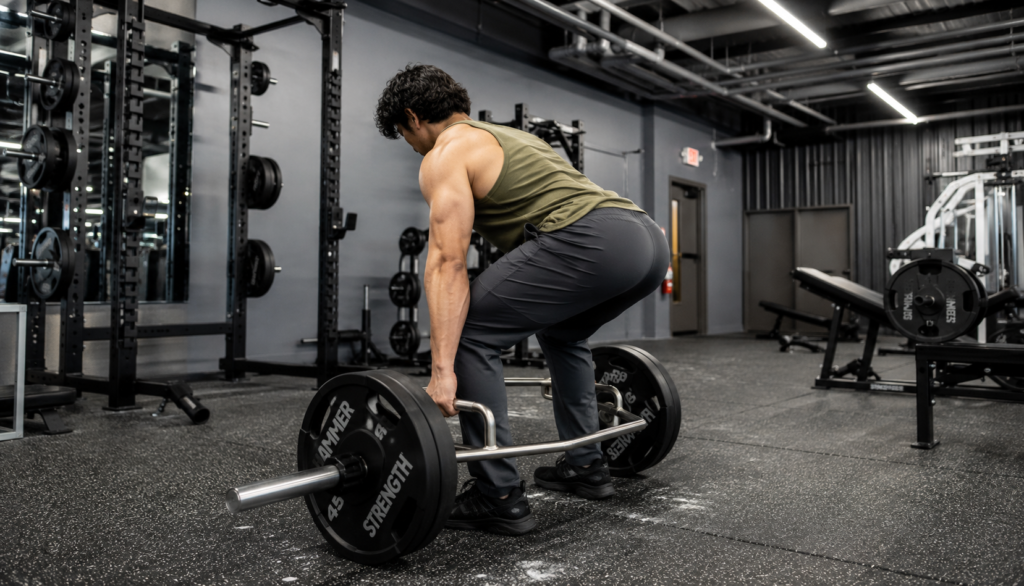
Conventional and sumo stance deadlifts load the hips and back differently, and most lifters find one stance allows a heavier pull than the other based on their proportions. The standards above assume a conventional pull; sumo numbers for the same lifter are often close but not always identical. Trap bar deadlifts tend to allow the heaviest numbers of the three for most lifters, since the more upright torso position and centered load reduce the lower-back demand of the pull — worth keeping in mind if you’re comparing your number to a friend’s without checking which variation they used.
Bar Speed and Grip
Grip strength is a common, overlooked limiter on deadlift standards, especially past the intermediate level. A lifter with a strong back and legs but an untrained grip may stall well below their true potential simply because the bar starts slipping before the target muscles are fatigued. Mixed grip, hook grip, or straps used in training (not competition) can all address this depending on your goals and whether you’re training for a meet with strict grip rules.
Training Toward the Next Level
Moving up a level on the standards table isn’t about pulling heavier every single session. It comes from a structured program that builds volume and intensity over time, adequate recovery between hinge-pattern training days, and technique that stays consistent as the load increases. Programs like Starting Strength or a 5×5 structure are common starting points precisely because they build the deadlift through gradual, trackable progressive overload rather than random heavy attempts.
For a novice, this usually means adding small amounts of weight across consecutive sessions while the movement pattern is still new enough to respond quickly. For an intermediate or advanced lifter, straight-line progression like this stops working, and moving up a bracket instead depends on structured variation — cycling volume and intensity across weeks, working accessory lifts that target a specific weak point, and being more deliberate about how close each session pushes to failure.
Recovery matters as much as the training itself here — the deadlift is one of the most systemically fatiguing lifts in a program, and under-recovering between sessions is one of the most common reasons progress stalls well below a lifter’s actual strength potential. Sleep quality, overall training volume across the week, and simply spacing heavy pulling sessions far enough apart all play a bigger role in long-term deadlift progress than most lifters expect.
When Your Numbers Don’t Match the Standards
If your deadlift ratio sits well below the table for your training age, it’s rarely a sign something is wrong — grip strength, hamstring flexibility, or simply low exposure to the movement pattern are common, fixable limiters. If your numbers sit well above the table early in training, it often reflects a strength base carried over from another sport or manual labor background, not an error in the standards themselves.
Either way, the standards are a reference point for planning your training, not a verdict on your progress. The most useful way to use this table is to check your own ratio now, note which bracket you’re in, and set your training around closing the gap to the next one — rather than comparing your number against a training partner whose bodyweight, limb length, and training history may look nothing like yours.