
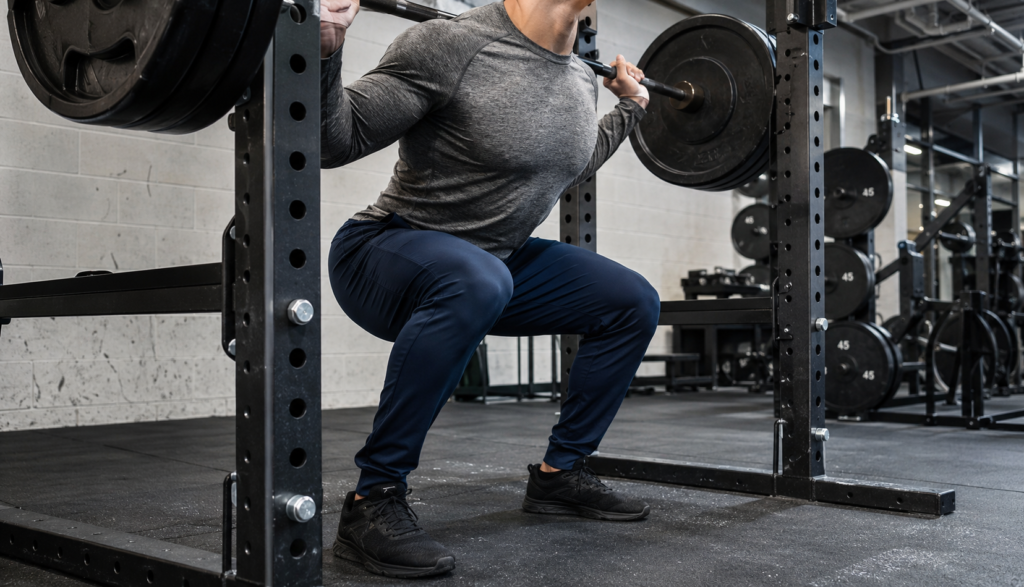
StrongLifts 5×5 is a beginner barbell strength program built around two alternating workouts, five compound lifts, and a simple rule: add weight every session until you can’t. It’s one of the most widely used entry points into structured strength training, largely because it removes almost every decision a new lifter would otherwise have to make.
This guide covers how the program is structured, how progression and deloading work, and who actually benefits from running it.
What Is StrongLifts 5×5?
StrongLifts 5×5 is a linear progression strength program based on two workouts, A and B, alternated three times per week. Each workout uses compound barbell lifts performed for five sets of five reps, with one exception built in for lower back fatigue management.
- Workout A: Squat 5×5, Bench Press 5×5, Barbell Row 5×5
- Workout B: Squat 5×5, Overhead Press 5×5, Deadlift 1×5
Squats appear in both workouts because they’re trained three times per week — the central driver of the program’s strength gains. Deadlift is dropped to a single working set since it’s heavily taxing and doesn’t need the same volume as squats to progress at the beginner stage.
How the Weekly Schedule Works
The standard setup is three non-consecutive training days — commonly Monday, Wednesday, Friday — alternating Workout A and Workout B. Over two weeks that looks like A, B, A, then B, A, B, so each workout gets trained roughly one and a half times per week on average.
Rest days between sessions matter here. Recovery between squat sessions is part of why the linear progression works in the early stages; skipping rest days or compressing the schedule undercuts the between-session recovery the program depends on.
The Progression Rule

The core mechanic of StrongLifts 5×5 is straightforward: add 2.5 kg (or 5 lb) to the bar every time you complete all five sets of five reps. This is progressive overload in its most literal form — small, mandatory, session-to-session increases with no plateaus built in by design.
Deadlift and Overhead Press typically progress the same way, though many lifters slow deadlift increases sooner since a single top set fatigues quickly relative to the load moved. The simplicity of the rule is the entire point — a true beginner’s nervous system and connective tissue can typically adapt fast enough to support weekly, sometimes session-to-session, load increases.
What Happens When You Fail a Set
Failure is built into the program’s logic rather than treated as an error. The standard rule:
- First failure: repeat the same weight next session.
- Second consecutive failure: repeat again.
- Third consecutive failure: deload that lift by 10%, then resume adding weight from there.
This three-strikes structure prevents lifters from grinding against a weight indefinitely or panicking and abandoning the program at the first missed rep. Failing a set is expected eventually — it’s the point where linear progression naturally starts to slow down.
Why Deloading Is Necessary Eventually
Linear progression has a shelf life. As working weights climb, the amount of recovery needed per session increases faster than a beginner’s ability to add weight every workout. The built-in 10% deload exists precisely because most lifters will hit repeated failures at some point, typically first on squat given its frequency and lower back demands.
A deload isn’t a sign the program has failed — it’s the mechanism by which the program keeps working for longer than pure linear addition would allow. Once deloads start happening frequently across multiple lifts in the same month, that’s usually the signal a lifter has outgrown straight linear progression and needs a program with built-in periodization instead.
Warm-Up Sets and Working Sets
The 5×5 in the name refers to working sets only. StrongLifts recommends warming up with several ascending sets — often starting from just the empty bar — before reaching the working weight. This isn’t optional volume; it’s how a lifter arrives at heavy working sets with the joints and nervous system primed, especially important for squat given how frequently it’s trained.
Equipment and Setup
StrongLifts 5×5 assumes access to a standard power rack or squat stand, a flat bench, and a barbell with enough plates to progress for months without running out of load. A rack with adjustable safety pins is functionally required, not optional — since the program pushes squat and bench weights up every session, having a way to bail safely on a failed rep matters from week one, not just once weights get heavy.
A few pieces of secondary equipment make the program noticeably smoother to run: chalk for grip on deadlift and rows as hands start to sweat under repeated heavy pulls, and a notebook or tracking app since the entire program hinges on knowing the exact weight and rep count from the previous session. Flooring matters too — deadlifting and racking heavy plates repeatedly is easier and quieter on rubber flooring than bare concrete, though this is a comfort factor rather than a requirement.
How StrongLifts 5×5 Compares to Starting Strength
StrongLifts 5×5 is frequently mentioned alongside Starting Strength, another linear progression program built around barbell compounds, and the overlap is real — both use two alternating workouts, both rely on adding weight every session, and both are designed for the same early-training window. The differences are in the details rather than the philosophy.
Starting Strength uses power cleans in place of barbell rows and a slightly different set/rep scheme on some lifts, along with a more prescriptive approach to bar speed and technique cues. StrongLifts 5×5 favors barbell rows for their lower technical demand and uses a flat 5×5 across all lifts except deadlift, which makes it somewhat more approachable for a lifter training without a coach present to correct technique in real time. Neither program is objectively superior — the choice usually comes down to whether a lifter wants to learn the Olympic-lift-style power clean or would rather stick to more straightforward barbell movements while building a base.
Nutrition and Body Weight Considerations

Because the program calls for near-constant load increases, body weight trends matter more here than in many other training styles. Lifters trying to add weight to the bar every session generally need to be in a slight calorie surplus, since building the muscle and connective tissue needed to support heavier lifts requires available energy and adequate protein intake to rebuild tissue between sessions.
Lifters attempting to run StrongLifts 5×5 while in an aggressive calorie deficit typically hit failed reps and deloads far sooner than lifters eating at maintenance or a slight surplus, simply because there isn’t enough recovery capacity to support the demands of near-daily heavy squatting. This doesn’t mean fat loss and the program are incompatible, but it does mean expectations should be adjusted — progression will likely be slower and deloads more frequent under a deficit than the standard program timeline assumes.
Who StrongLifts 5×5 Is Best For
The program is designed specifically for lifters in their first months of structured barbell training, sometimes called “the beginner gains” or “newbie gains” window — the period where strength can be added almost every session because the body is far from its genetic ceiling and adapts unusually fast.
It suits lifters who want a simple, low-decision structure: three lifts per session, a fixed rep scheme, and one clear rule for adding weight. It’s less useful for anyone who has already spent a year or more under a barbell, since intermediate lifters generally need more volume variation and a training week that isn’t built around near-daily maximal squatting.
Common Limitations of the Program
A few structural trade-offs are worth knowing before starting:
- Minimal upper body volume. Bench, row, and overhead press each get one 5×5 slot per week, which is light compared to hypertrophy-focused splits.
- No accessory work by default. The base program doesn’t include isolation or accessory movements, though many lifters add limited accessories once the main lifts stabilize.
- Squat frequency can be demanding. Squatting three times a week is effective early on but can become difficult to recover from as loads increase, particularly without attention to sleep and overall calorie intake.
- Linear progression has a natural endpoint. Every beginner eventually needs to transition to a program with planned volume changes rather than constant weight increases.
Tracking Progress and Recovery
Because the program is driven entirely by whether a lifter completes all reps, tracking each session’s weights is essential — there’s no room for guessing what was lifted last time. Recovery inputs matter just as much as the training itself here: adequate sleep and sufficient calorie and protein intake are what allow the body to actually adapt to the frequent load increases the program calls for, rather than accumulating fatigue that shows up as stalled or failed sets.
Transitioning Off the Program
Most lifters move off strict linear progression within three to six months, depending on training age, body weight, and recovery capacity. The usual signal is hitting deloads on more than one lift within the same few weeks — at that point, a program with built-in weekly or monthly volume variation typically produces better long-term results than continuing to force linear jumps.