

The 5×5 workout program is one of the oldest and most reliable templates in strength training. Five sets of five reps, built around a handful of compound lifts, repeated week after week with small, steady weight increases. No frills, no complicated periodization charts, no guesswork about what to do when you walk into the gym.
That simplicity is exactly why it has stuck around for decades. It works well for building a strength base, it’s easy to track, and it gives beginners and early intermediates a clear path to follow. This guide breaks down how the structure works, how progression is supposed to happen, and who gets the most out of training this way.
What Is the 5×5 Method?
At its core, 5×5 means five sets of five repetitions performed on a main compound lift, using the same working weight across all five sets. Rather than chasing a single all-out set, you accumulate volume across five submaximal sets. This spreads out the training stress, reinforces technique under a heavier bar than you’d usually load for higher-rep work, and builds strength through repeated, consistent exposure to a challenging weight.
The method typically centers on a short list of barbell movements: squat, bench press, deadlift, overhead press, and a row or pull-up variation. These lifts hit the major muscle groups and movement patterns your body needs for general strength, and they scale well with added weight over time, which is the entire point of a program built around gradual load progression.
Why Five Sets and Five Reps?
Five reps sits in a sweet spot between pure strength work (lower reps, higher intensity) and hypertrophy-focused rep ranges. It’s heavy enough to build real strength but light enough that form holds up across multiple sets. Five sets gives enough total volume to drive adaptation without pushing a beginner into a recovery hole they can’t climb out of before the next session.
This combination is also easy to standardize. There’s no need to calculate percentages of a one rep max or juggle wave-loading schemes. You pick a weight, do five sets of five, and if all five sets are clean, you add weight next session.
Weekly Structure
Most 5×5 programs run on a three-day-per-week split, with the same core lifts rotating across two alternating workouts. A common layout looks like this:
| Day | Main Lift | Secondary Lift | Accessory |
|---|---|---|---|
| Workout A | Squat | Bench Press | Row |
| Workout B | Squat | Overhead Press | Deadlift (1×5) |
Workout A and Workout B alternate across the week — for example, A on Monday, B on Wednesday, A on Friday, then B the following Monday. Squat appears in nearly every session because it’s the primary strength driver in most 5×5 templates, while deadlift is usually trained for a single working set of five, since its recovery demand is higher than the other lifts.
Rest Days Matter as Much as Training Days
The three-times-a-week frequency isn’t arbitrary. It gives each muscle group roughly 48 hours of recovery before it’s loaded heavily again, which matters when you’re adding weight to the bar every session. Skipping rest days or training the same lift back-to-back with no recovery window is one of the fastest ways to stall progress or get hurt on this kind of program.
A typical week looks like Monday, Wednesday, Friday, with the weekend and Tuesday/Thursday left open for full recovery. This isn’t just about muscular soreness — the central nervous system also needs time to recover from heavy, near-maximal lifting, and that recovery happens on rest days, not during the workout itself. Lifters who try to compress the schedule into four or five sessions a week, hoping to progress faster, often find the opposite happens: fatigue accumulates, bar speed drops, and technical form starts to slip under load.
What Equipment You Actually Need

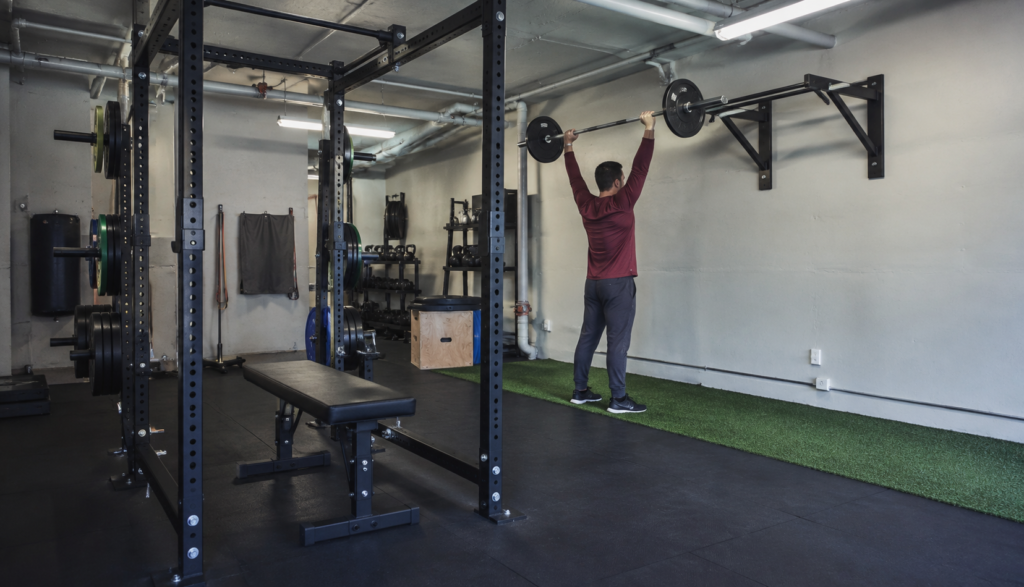
A 5×5 program is deliberately low-tech in its equipment demands, which is part of why it’s such an accessible starting point. A barbell, a set of weight plates, a squat rack or power cage, and a flat bench cover every lift in the standard rotation. Access to a pull-up bar is useful for the row or pull-up variation, though a cable row or dumbbell row works as a substitute if a barbell row isn’t comfortable yet. Chalk can help with grip on heavier deadlift and row sets, and a pair of flat-soled training shoes gives a more stable base for squatting than running shoes with a cushioned heel.
How Progression Works
Progression on a 5×5 program is linear: if you complete all five sets of five reps at a given weight with good form, you add weight — commonly 5 pounds on upper body lifts and 5 to 10 pounds on squat and deadlift — at your next session for that lift. This is what makes the program so appealing to beginners. Progress is visible, measurable, and happens almost every workout in the early stages.
This linear phase doesn’t last forever. As the weights get heavier, your body’s ability to recover between sessions slows down, and the jumps that felt trivial early on start to feel much harder to complete. This is normal and expected, not a sign something is wrong with the program.
What to Do When You Stall
A stall — failing to complete all reps on a lift for two or three sessions in a row — is the point where most lifters need to adjust rather than push through blindly. Common fixes include:
- Deloading the lift by around 10% and building back up more gradually
- Reducing the weight jump size, for example moving from 5-pound to 2.5-pound increments
- Adding an extra rest day if recovery, sleep, or nutrition are limiting factors
- Reassessing whether volume elsewhere in the week is interfering with recovery
Stalling is a normal part of any linear progression model. It signals that the easy, fast-progress phase of training is ending and that smaller, more patient adjustments are needed going forward.
Who Should Use a 5×5 Program?
5×5 training is best suited to beginners and early intermediates who haven’t yet exhausted the benefits of simple linear progression. If you’re new to barbell training or returning after a long layoff, your body can typically handle and adapt to small, frequent weight increases for weeks or months before progress naturally slows.
It’s less ideal for advanced lifters who have already built a solid strength base, since their recovery capacity per session is usually outpaced by how much weight they’d need to add to keep progressing linearly. At that stage, more advanced periodization models that vary volume and intensity across weeks tend to produce better results than a straight 5×5 format.
5×5 for Fat Loss or General Fitness
While 5×5 is built around strength, it can fit into a broader fitness or body recomposition goal as the resistance training component. The compound lifts burn meaningful energy and build the muscle mass that supports a higher metabolic rate, but the program itself doesn’t dictate diet. Pairing consistent 5×5 training with an appropriate calorie target — whether that’s a deficit, maintenance, or surplus — is what determines whether the outcome leans toward fat loss, recomposition, or muscle gain.
Common Mistakes on a 5×5 Program
A few recurring issues tend to slow people down or derail their results on this style of program:
- Adding weight too fast: Sticking rigidly to a weight jump even when form breaks down leads to injury risk and eventual failed sessions.
- Skipping warm-up sets: Jumping straight into five heavy working sets without a proper ramp-up increases injury risk and hurts performance on the working sets themselves.
- Ignoring recovery factors: Sleep, food intake, and stress all directly affect how well your body can recover between sessions and keep progressing.
- Adding too many accessory exercises: The simplicity of 5×5 is part of its effectiveness. Piling on extra volume can interfere with recovery from the main lifts.
- Not tracking numbers: Without a written log of weights, sets, and reps, it’s easy to lose track of whether you actually completed a session cleanly or need to repeat the weight.
5×5 vs. Other Beginner Strength Programs
5×5 is one of several linear progression templates built around similar principles — full-body sessions, a short list of compound lifts, and small, frequent weight increases. What separates different versions of this approach is mainly the exact set and rep scheme, which lifts are prioritized each session, and how often each lift is trained per week. The underlying logic of progressive overload through consistent, trackable weight increases stays the same across most beginner-focused strength templates.
How Long Should You Run a 5×5 Program?
There’s no fixed end date built into the 5×5 method, but most lifters get somewhere between three and nine months of steady linear progress before stalls become frequent enough to signal it’s time for a change. Newer, smaller, or lighter lifters often progress for longer because they have more room to add weight before hitting the limits of what their recovery capacity can support. Lifters who come in with some existing strength background tend to exhaust the easy gains faster, sometimes within a couple of months.
The transition point isn’t really about a calendar date — it’s about how often stalls are showing up and how much adjusting is needed to keep moving forward. Once you’re deloading or adjusting increments on most lifts every few weeks rather than making clean weekly progress, that’s a sign your body has adapted to what linear progression can offer and a program with more built-in variation in volume and intensity will likely serve you better from that point on.
Tracking Your Progress
Because 5×5 progression is so numbers-driven, keeping a simple log is essential. Note the weight, sets, and reps completed for every lift, every session. Over a few months, that log becomes a clear record of your strength gains and makes it obvious exactly when a stall is happening and how long it’s been going on. If you’re also tracking bodyweight and want to understand how your added muscle and strength are translating into overall composition changes, a body recomposition calculator can help connect the two.
Final Thoughts
The 5×5 method endures because it removes the guesswork from early strength training. Five sets, five reps, a short list of compound lifts, and a simple rule for adding weight is enough to drive real progress for months when you’re new to barbell training. The key is following the structure consistently, respecting rest days, and adjusting — rather than abandoning the program — the moment a stall shows up.