

The overhead press is one of the hardest lifts to progress. It works a small group of muscles, it gets almost no help from your legs, and every extra pound feels heavy. So it is normal to wonder whether your press is good, weak, or somewhere in the middle. This guide gives you real numbers to compare against.
You will see the average overhead press for men and women, how it shifts with bodyweight, age, and training experience, and how to test your own number safely. You will also get clear steps to push your press past average.
What Is the Average Overhead Press?
Training logs from thousands of lifters put the average overhead press at about 126 pounds (57 kilograms) for men and about 66 pounds (30 kilograms) for women. Those figures are a one rep max, or 1RM, which is the heaviest weight you can lift for a single clean rep. They describe an average lifter who trains regularly, which lands at the intermediate level.
The overhead press is also called the military press or strict press. You stand, press a barbell from your collarbone to a full lockout over your head, and use no leg drive. A seated dumbbell shoulder press is a different exercise with different numbers, so do not compare the two directly.
If you have never trained, expect to start lower. A new male lifter presses around 71 pounds, and a new female lifter presses around 33 pounds. These are normal starting points, not signs of weakness. The press responds well to steady work, and the early gains come quickly.
Average Overhead Press by Experience Level
Strength standards sort lifters into five levels based on how much they press compared with everyone else in the data. The numbers below are one rep maxes in pounds, averaged across all bodyweights.
| Level | Men (lb) | Women (lb) |
|---|---|---|
| Beginner | 71 | 33 |
| Novice | 104 | 55 |
| Intermediate | 126 | 66 |
| Advanced | 150 | 79 |
| Elite | 194 | 106 |
Beginner means you are new or untrained. Novice usually means a few months of regular training. Intermediate points to a year or two of steady lifting. Advanced and elite take years of focused strength training, and few people reach them. Treat the labels as rough guides, because training experience depends on how hard and how consistently you train.
Average Overhead Press by Bodyweight
Heavier lifters tend to press more because they carry more muscle mass, but the gain is not one to one. A lifter who doubles in size does not double their press. That is why strength standards are usually listed by bodyweight instead of as one flat number.
Men
This table shows the novice and intermediate marks for men at four bodyweights.
| Bodyweight (lb) | Novice | Intermediate |
|---|---|---|
| 150 | 88 | 103 |
| 180 | 101 | 120 |
| 210 | 113 | 134 |
| 240 | 122 | 146 |
Women
Here are the same two marks for women at four bodyweights.
| Bodyweight (lb) | Novice | Intermediate |
|---|---|---|
| 110 | 48 | 58 |
| 130 | 51 | 62 |
| 150 | 53 | 65 |
| 170 | 55 | 68 |
In terms of relative strength, also called strength-to-weight ratio, an intermediate man presses roughly 60 to 70 percent of his bodyweight, and an intermediate woman presses roughly 40 to 55 percent of hers. Use this as a quick check when your bodyweight does not match a row in the tables. Pressing your full bodyweight overhead is a big milestone, and for most men it sits near the elite level.
Average Overhead Press by Age
Pressing strength holds steady from the twenties into the early forties for most people. After that it slowly declines. Large lifting logs show that lifters in their fifties press about 10 percent less than lifters in their thirties and forties, and lifters in their sixties press about a quarter less. Muscle mass, joint health, and shoulder mobility all play a part.
That does not mean you should accept a lower press as you get older. Lifters who keep training lose far less strength than people who stop. Use your own past numbers as your main comparison, and use the averages only as a loose reference.
Why the Overhead Press Is Lower Than the Bench Press

Most lifters press far less overhead than they bench. A common rule of thumb puts the overhead press at about 60 to 70 percent of your bench press. Several things explain the gap. The press relies on the deltoids and triceps, while the bench press adds the large chest muscles. You also press from a standing position, so your core stability and upper back must hold the bar steady with nothing to brace against.
The squat and deadlift sit much higher than both, because they use the biggest muscles in the body. Powerlifting meets score the squat, bench press, and deadlift, and the overhead press is left out. Expect your press to be one of your lightest barbell lifts.
How to Check Your Own Overhead Press Number
Estimate Your 1RM From a Rep Set
A true max overhead is hard to test safely, because the shoulders tire fast and a missed rep over your head is awkward to bail from. A safer route is to do one hard set of three to five reps with good form, then estimate your max. The Epley formula multiplies the weight by 1 plus the reps divided by 30. For example, 95 pounds for five reps gives 95 × (1 + 5 ÷ 30), which is about 111 pounds.
Do two or three lighter warm-up sets first, rest at least three minutes between working sets, and stop the set when your bar path starts to drift forward.
Compare Your Result to the Standards
Once you have an estimate, run it through the one rep max calculator on CalcLifting to confirm the math. Then check it in the strength level calculator to see whether you land at novice, intermediate, or advanced for your sex and bodyweight. Retest every eight to twelve weeks instead of every week, because the press moves slowly.
How to Raise Your Overhead Press Above Average
Clean Up Your Setup and Bar Path
Stand with your feet about hip width apart and squeeze your glutes to lock your hips. Keep your ribs down so your lower back does not arch. Start with the bar on your upper chest and your elbows slightly in front of it. As the bar rises, move your head back so the bar travels in a straight line, then push your head through at the top so the bar finishes over your mid-foot. Good form wastes less energy and keeps your shoulders healthy.
Add Weight in Small Steps
Progressive overload is the main driver of a bigger press. Because the overhead press is a small-muscle lift, jumps of 5 pounds can stall you fast. Use fractional plates to add 2.5 pounds (1 kilogram) each time you hit your target reps. Work in a rep range of three to six for your heavy sets, then add a lighter back-off set of eight to ten reps for extra volume.
Build the Muscles That Support the Press
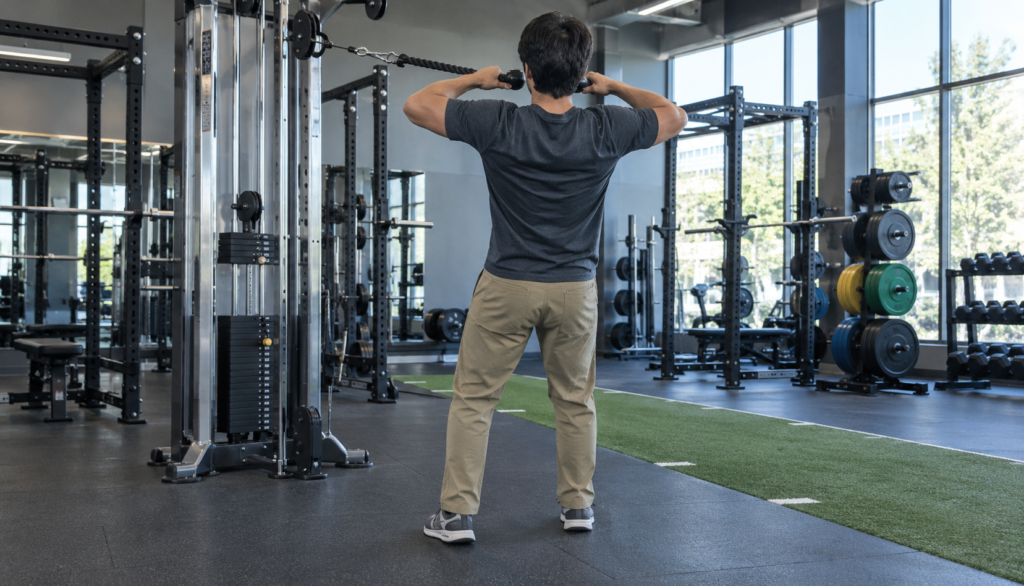
A strong press needs more than strong shoulders. Close-grip bench press and dips build the triceps, which finish the lockout. Rows and face pulls strengthen the upper back and rotator cuff, which keep the shoulder stable under load. Planks and carries build the core so your body does not bend under the bar. A dumbbell shoulder press adds muscle to the deltoids through a longer range of motion, and a push press lets you handle heavier weight overhead and practice a strong lockout.
Work on shoulder mobility and thoracic spine mobility too. If your upper back is stiff, your ribs flare and your lower back takes over the lift.
Train It Often and Recover Well
Most lifters make better progress pressing two or three times per week than once. Training frequency matters because both the skill and the muscle improve with repeated practice. Keep each session light enough that you recover before the next one, since good recovery is where the gains show up. Sleep seven to nine hours, eat enough protein and calories, and take a deload week when your reps stop moving up for several sessions in a row.
Why Your Press May Be Stuck
Three problems cause most stalls. The first is too much shoulder work from other lifts, which leaves your deltoids tired before you press. The second is leaning back to finish reps, which turns the lift into a weak incline press and hides the real weak point. The third is jumping the weight too fast. Fix these and your progress often returns.
The Takeaway
The average overhead press is about 126 pounds for men and 66 pounds for women, but your best target is the next level up for your own bodyweight and age. Find your estimated 1RM, compare it to the strength standards, and pick one weak link to work on. Add weight slowly, press often, and recover well. A bigger overhead press comes from steady, patient work, not from big jumps.