
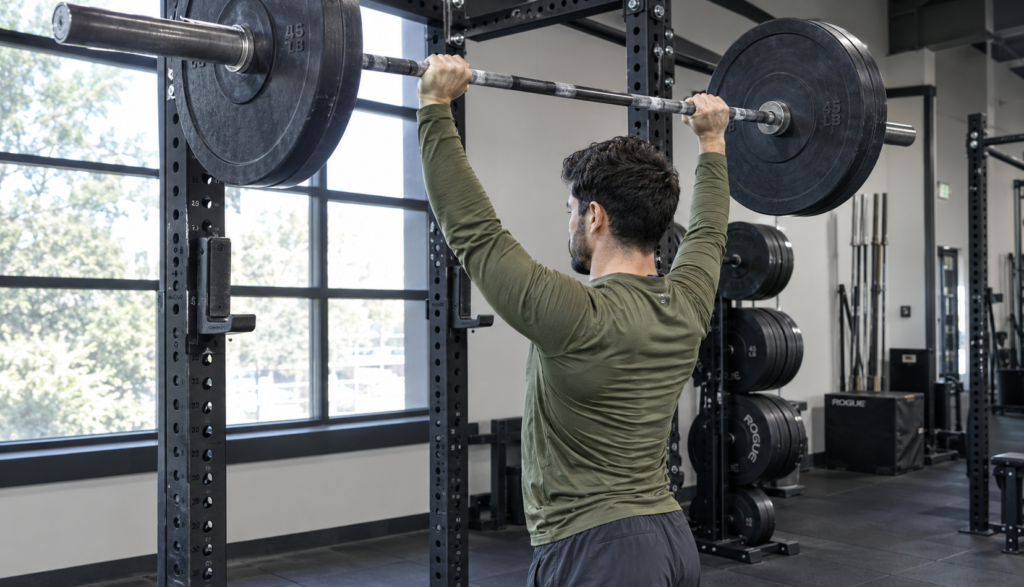
The overhead press is the hardest of the big barbell lifts to move up. Squats and deadlifts climb fast, and the bench press follows close behind, but the shoulder press, also called the military press, stalls early and stays stalled for months. That makes it tough to know where you stand. Is 95 pounds overhead good? Is 135 pounds strong, or just average?
This guide gives you clear overhead press standards for men and women, from beginner to elite. You will see what a good overhead press looks like at your bodyweight, how to test your one rep max safely, and what to change when your numbers stop moving. All the numbers are for the strict, standing overhead press with a barbell.
What Counts as a Good Overhead Press?
A good overhead press depends on your bodyweight, your training age, and the style of press you use, so no single overhead press weight fits everyone. A 130-pound lifter and a 230-pound lifter should not chase the same number, so most strength standards use a bodyweight ratio. You divide the weight on the bar by your bodyweight and compare the result to a level.
The standards below describe a single rep at your one rep max (1RM), done as a strict press with no leg drive. Lifters usually sort into five levels:
- Beginner: You have just started strength training and can press a light load with clean form.
- Novice: You have trained consistently for a few months and add weight often.
- Intermediate: You have trained for one to two years and progress is slower.
- Advanced: You have trained for several years and gains come in small steps.
- Elite: You press at a level only a small share of lifters ever reach.
Most people who train regularly land between novice and intermediate. That is a solid place to be. The average overhead press for an untrained adult is far lower than the numbers gym-goers talk about online.
Overhead Press Standards for Men
For men, the strength level ratios below are a reliable guide. They are approximate, and different sources vary a little, but they match what most experienced lifters see in real gyms.
- Beginner: about 0.35 times bodyweight
- Novice: about 0.55 times bodyweight
- Intermediate: about 0.80 times bodyweight
- Advanced: about 1.10 times bodyweight
- Elite: about 1.40 times bodyweight
Here is what those ratios look like in pounds at common bodyweights, rounded to the nearest 5 pounds. Kilograms are in the last note below the table.
| Bodyweight | Beginner | Novice | Intermediate | Advanced | Elite |
|---|---|---|---|---|---|
| 150 lb | 55 lb | 85 lb | 120 lb | 165 lb | 210 lb |
| 180 lb | 65 lb | 100 lb | 145 lb | 200 lb | 250 lb |
| 200 lb | 70 lb | 110 lb | 160 lb | 220 lb | 280 lb |
| 220 lb | 75 lb | 120 lb | 175 lb | 240 lb | 310 lb |
To convert to kilograms, divide the pounds by 2.2. A 180-pound man with an intermediate press lifts about 145 pounds, or roughly 66 kilograms.
Notice how far the elite column sits from the rest. Pressing your own bodyweight overhead is a major milestone for men, and 1.4 times bodyweight is rare outside dedicated powerlifting circles.
Overhead Press Standards for Women
Women use the same five levels, but the ratios are lower because the average woman carries less upper body muscle mass. The standards are not a judgment. A woman who reaches intermediate has built serious upper body strength.
- Beginner: about 0.20 times bodyweight
- Novice: about 0.35 times bodyweight
- Intermediate: about 0.55 times bodyweight
- Advanced: about 0.80 times bodyweight
- Elite: about 1.05 times bodyweight
| Bodyweight | Beginner | Novice | Intermediate | Advanced | Elite |
|---|---|---|---|---|---|
| 110 lb | 20 lb | 40 lb | 60 lb | 90 lb | 115 lb |
| 130 lb | 25 lb | 45 lb | 70 lb | 105 lb | 135 lb |
| 150 lb | 30 lb | 50 lb | 85 lb | 120 lb | 160 lb |
| 170 lb | 35 lb | 60 lb | 95 lb | 135 lb | 180 lb |
An empty 45-pound barbell is a real starting point for many women, and many men too. If you cannot press the bar yet, start with a lighter bar, dumbbells, or a landmine press, and build up from there.
Why Do Standards Change With Bodyweight?
Heavier lifters usually have more muscle, so they press more in total. The press does not scale in a straight line, though. A lifter who doubles in size does not double the weight on the bar. Ratios are a fair rough guide for most lifters, but at very light or very heavy bodyweights, treat them as a rough target, not a strict rule.
How to Test Your Overhead Press Max
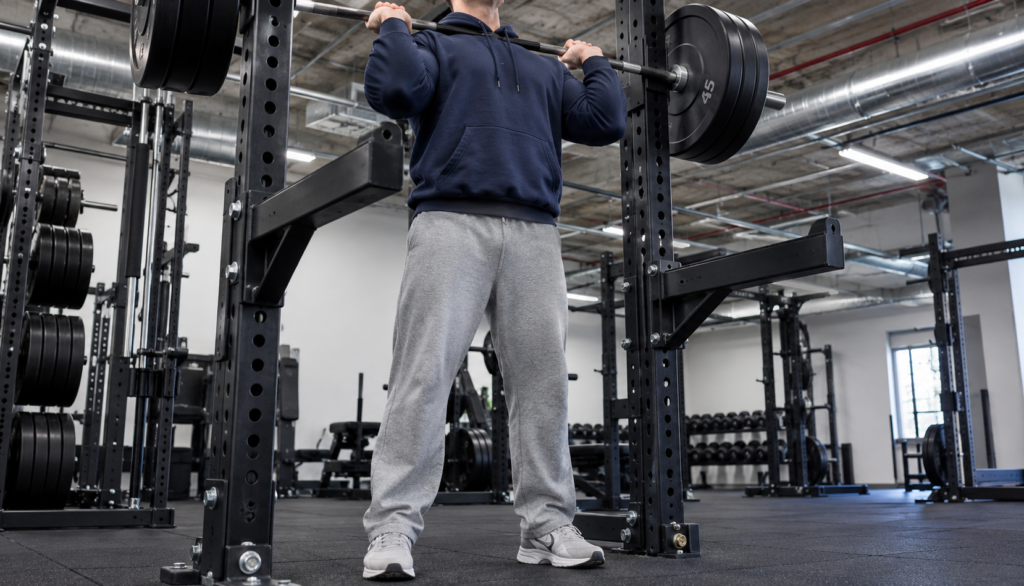
You do not need to grind out a true max to find your level. A heavy set of three to five reps gives you a safe estimate. Use a rep max formula or a one rep max calculator to convert it into a 1RM, then compare it to the tables above.
If you want to test a true max, follow these steps:
- Warm up with an empty bar, then add weight in warm-up sets of five, three, and one rep.
- Rest at least three minutes between heavy attempts. A longer rest time gives better results.
- Add small jumps near your max. Five pounds is plenty.
- Use a rack with safety arms set just below chin height, so you can drop the bar if a rep fails.
- Stop when form breaks down. A grinding rep with a leaning back is not a clean max.
Keep the test strict. A push press, where your legs drive the bar up, will always let you lift more weight. It is a great lift, but it does not count for these standards.
Why Is the Overhead Press Lower Than the Bench Press?
Most lifters press much less overhead than they bench. A common rule of thumb is that your overhead press lands around 60 to 65 percent of your bench press. If you bench 200 pounds, a 125-pound strict press is a normal result.
There are good reasons for the gap. The standing overhead press uses a smaller group of muscles, mainly the deltoids and triceps, with less help from the chest. You also press from a standing position, so your core and glutes must hold your body steady while the bar moves in a tight path over your head. Any weakness in your trunk or hips shows up right away.
How to Move Up a Level
If your press has stalled, the fix is usually simple. Small, steady jumps and enough recovery beat random hard sessions.
Add Weight in Smaller Steps
Jumping five pounds a week works for a short time, then it stops. Switch to microloading with fractional plates, which let you add as little as one pound at a time. Over a few months, those small jumps add up to a big gain, and they fit a linear progression better than large jumps do.
Train the Press More Often
Training frequency matters here. Pressing once a week is rarely enough. Two or three sessions per week give your shoulders more practice and speed up progress. Keep the weekly volume reasonable, and use a different rep range on each day, such as heavy sets of five and lighter sets of eight to ten.
Build the Muscles That Support the Lift
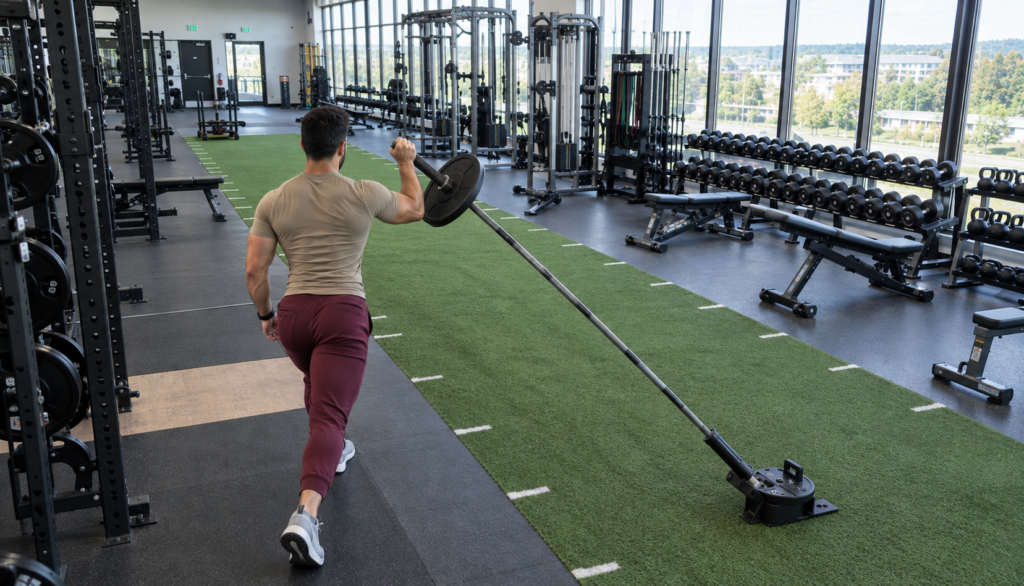
Strong support muscles protect your shoulders and add power. Add dips for your triceps, lateral raises for the side delts, and face pulls and rear delts work to keep the rotator cuff healthy. A dumbbell overhead press also helps because each arm has to work on its own, which exposes weak sides.
Fix Your Setup and Mobility
A stiff upper back forces you to lean back, which turns the press into a messy incline press. Work on thoracic mobility and overhead mobility so your arms can reach a stacked lockout. Squeeze your glutes, brace your core, and think about full scapular upward rotation at the top. That keeps the bar over your mid-foot and your spine in a neutral line.
Use Progressive Overload and Schedule Deloads
Progressive overload means doing a little more over time, whether that is more weight, more reps, or better form. When progress stalls for two or three weeks and your shoulders feel beaten up, take a deload week and cut your weights by about 10 to 20 percent. You will often come back stronger.
Common Overhead Press Mistakes to Avoid
- Leaning back too far. A small lean is natural, but a big arch shifts the load to your lower back.
- Pressing in front of your face. Move your head back as the bar passes, then push it through once the bar clears your chin.
- Letting the elbows flare wide. Keep your forearms close to vertical to protect your shoulders.
- Skipping the lockout. Finish with the bar over your mid-foot, arms straight, and shoulders shrugged up.
Where Do You Stand?
Your overhead press standard is a snapshot, not a verdict. Find your bodyweight in the tables, compare your one rep max, and pick the next level as your goal. Most lifters can move up a full level in six to twelve months with steady training and patience.
Use the CalcLifting one rep max calculator to turn your best set into a clean estimate, then check it against the strength level calculator to see how your press compares with your other lifts. Retest every couple of months, keep your reps strict, and the numbers will follow.