

Bench press strength isn’t static. It builds through your twenties and thirties, often peaks somewhere in early middle age, and gradually declines later in life if training stops being consistent. Age is one of the biggest factors influencing average bench press numbers, right alongside bodyweight and training experience, yet it’s rarely talked about with much nuance.
Knowing how bench press strength typically trends by age group gives useful context. It helps you understand whether a plateau is a normal part of aging, a sign that your program needs adjusting, or simply a natural point in the strength curve that most lifters pass through.
Why Age Affects Bench Press Strength
Several physiological factors drive the way strength changes with age. Understanding them makes the average bench press numbers by age group make a lot more sense.
Muscle Mass and Testosterone
Testosterone levels, which play a significant role in muscle mass and strength development, generally peak in the late teens and twenties before gradually declining with age. This decline contributes to slower strength gains and, eventually, a harder time maintaining peak muscle mass without consistent resistance training.
Neuromuscular Efficiency
Younger lifters often see faster strength gains early on due to neuromuscular adaptation — the nervous system becoming more efficient at recruiting muscle fibers for a given movement. This effect is strongest in the first few years of training, which is part of why bench press numbers can climb quickly for beginners regardless of age.
Recovery Capacity
Recovery ability tends to slow with age, meaning older lifters often need more time between heavy pressing sessions to allow full recovery. This doesn’t mean strength training becomes less effective with age, but programming often needs to account for a slower recovery curve.
Average Bench Press by Age Group
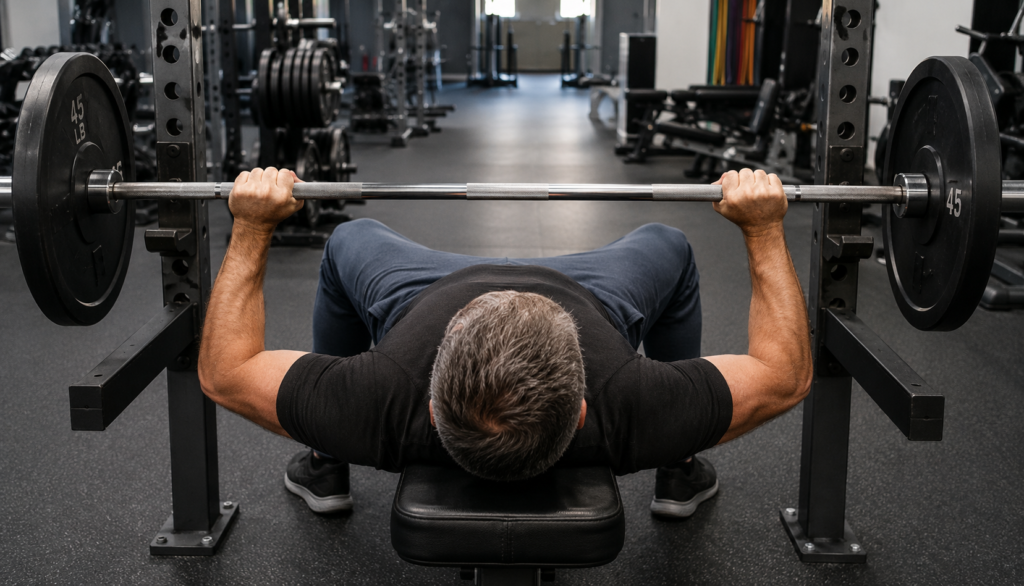
These figures represent general trends for recreationally trained lifters and should be read as broad reference points rather than fixed targets, since bodyweight, training experience, and consistency all shift the numbers significantly.
| Age Range | General Strength Trend |
|---|---|
| 18-25 | Rapid strength gains, often the fastest progress window due to neuromuscular adaptation and naturally high testosterone levels. |
| 26-35 | Strength typically peaks during this range for lifters who train consistently, with well-developed technique supporting higher loads. |
| 36-45 | Strength often plateaus or shows a slight decline if training volume or recovery isn’t adjusted, though many lifters maintain near-peak numbers. |
| 46-55 | Gradual decline becomes more common, though consistent resistance training significantly slows this trend compared to sedentary adults. |
| 56+ | Strength maintenance becomes the priority over building new maxes, with recovery and joint health playing a larger role in programming decisions. |
Bodyweight Still Matters More Than Age Alone
Age influences bench press strength, but bodyweight remains one of the strongest predictors of how much someone can lift. A 45-year-old lifter at 200 pounds with years of consistent training will often out-bench a 22-year-old at 140 pounds who just started lifting. This is why relative strength — strength measured against bodyweight — often tells a more useful story than age alone.
This is also why a strength level calculator that accounts for bodyweight, sex, and training experience gives a more accurate picture than age-based averages by themselves. Age provides context, but it’s one variable among several that shape a realistic strength standard.
Training Age vs. Biological Age
Training age — how long someone has trained with consistency and intent — often matters more than biological age when predicting bench press strength. A 40-year-old with fifteen years of consistent training will typically out-bench a 25-year-old who started lifting last year, even though biological age suggests otherwise.
This distinction matters because it shifts the focus toward controllable factors. While biological age can’t be changed, training age and consistency can be built over time, and that has a much bigger long-term impact on bench press strength than the number of birthdays someone has had.
How to Keep Bench Press Strength Progressing With Age

Prioritize Recovery
As recovery capacity naturally slows, spacing out heavy pressing sessions and paying closer attention to sleep and nutrition becomes more important for continued progressive overload.
Manage Joint Health
Shoulder and elbow health becomes a bigger factor in long-term bench press progress with age. Incorporating mobility work, proper warm-ups, and balanced accessory training helps protect joints while still allowing strength gains.
Adjust Training Volume
Older lifters often respond better to slightly lower training volume with higher intensity, rather than very high-volume programs that may outpace recovery capacity.
Stay Consistent
Consistency matters more than intensity at any age. Lifters who train steadily through their thirties, forties, and beyond typically maintain strength far better than those who train in short, inconsistent bursts.
When to Worry About a Declining Bench Press
A gradual, minor decline over years is a normal part of aging, especially past age 40 or 50. What’s worth paying closer attention to is a sudden or sharp drop in strength, which can sometimes point to inadequate recovery, overtraining, poor sleep, nutritional gaps, or an underlying health issue rather than simply age-related decline.
Tracking your numbers over time, rather than relying on memory, makes it much easier to tell the difference between a normal plateau and something that needs closer attention.
Final Thoughts
Average bench press numbers do shift with age, driven by testosterone levels, neuromuscular efficiency, and recovery capacity. But age is only one part of the picture. Bodyweight, training age, and consistency all play a major role in determining actual bench press strength, often outweighing biological age on their own. Understanding these trends helps set realistic expectations and keeps training focused on the factors that are actually within your control.