
Powerlifting and bodybuilding both live inside the same gyms, use a lot of the same equipment, and both build people who are strong and muscular. That overlap is exactly why the two get confused so often. But the training goal behind each one is fundamentally different, and that difference shapes everything from how you program your workouts to how you eat to how progress actually gets measured.
If you’re trying to decide which style fits your goals, or you’re just curious why a powerlifter and a bodybuilder can look and train so differently despite both being “strength athletes,” this breakdown covers the real differences in training, competition format, physique outcomes, and day-to-day programming.
What Is Powerlifting?
Powerlifting is a strength sport built around three lifts: the squat, bench press, and deadlift. Competitors get three attempts at each lift, and the goal is simple — lift the most weight possible for a single rep on each one. Your total (the sum of your best squat, bench, and deadlift) determines your ranking within your weight class.
Because the entire sport is judged on maximal load moved, powerlifting training is built around getting stronger on those three specific movements. Everything else in a powerlifting program — accessory work, mobility, conditioning — exists to support the big three, not to compete with them for recovery or training time.
Competitions are organized by weight class and often by age group and equipment category (raw vs. equipped, meaning with or without supportive gear like squat suits or bench shirts). Meets are sanctioned by federations, and lifters compete against others in the same class rather than the field as a whole, which is part of why body weight management matters even though leanness itself isn’t judged.
What Is Bodybuilding?
Bodybuilding is a physique sport. Competitors are judged on muscle size, symmetry, conditioning (how lean and defined the muscle looks), and overall stage presence — not on how much weight they can lift. There’s no load requirement at all. A bodybuilder could win a show without ever attempting a heavy single on any lift.
Because the judging criteria is entirely visual, bodybuilding training is built around maximizing muscle growth (hypertrophy) across every major muscle group, along with the diet and conditioning work needed to reveal that muscle on stage.
Bodybuilding also has multiple competitive divisions beyond traditional bodybuilding, including classic physique, men’s physique, and bikini or wellness divisions for women. Each division has different judging emphasis — some reward extreme muscle size, others prioritize a leaner, more athletic look — but all of them are still scored on appearance rather than strength output.
Powerlifting vs Bodybuilding: The Core Differences
| Category | Powerlifting | Bodybuilding |
|---|---|---|
| Primary Goal | Maximal strength on squat, bench, deadlift | Muscle size, symmetry, and conditioning |
| Judged On | Total weight lifted | Visual physique appearance |
| Rep Ranges | Mostly low (1–6 reps) | Mostly moderate (8–15 reps) |
| Exercise Selection | Narrow — big three plus supporting accessories | Broad — targets every muscle group directly |
| Training Frequency per Lift | High frequency on competition lifts | Varies by muscle group split |
| Diet Focus | Fuel performance, hit weight class | Precise body composition and stage leanness |
Training Style: Strength vs Hypertrophy
How Powerlifters Train
Powerlifting programming centers on progressive overload with heavy loads and low reps, usually in the 1–6 rep range for the main lifts. Sessions are structured around specific percentages of a lifter’s one-rep max, often tracked with a one rep max calculator to plan training blocks. Volume on the competition lifts tends to be high relative to other movements, since skill and strength on the squat, bench, and deadlift are the entire point.
Accessory exercises still show up — things like rows, lunges, or triceps work — but they’re chosen to fix weak points in the big three, not to build a balanced, symmetrical physique. A powerlifter with a weak lockout might do a lot of close-grip bench and triceps extensions specifically to improve that sticking point, not because triceps size matters for judging.
How Bodybuilders Train
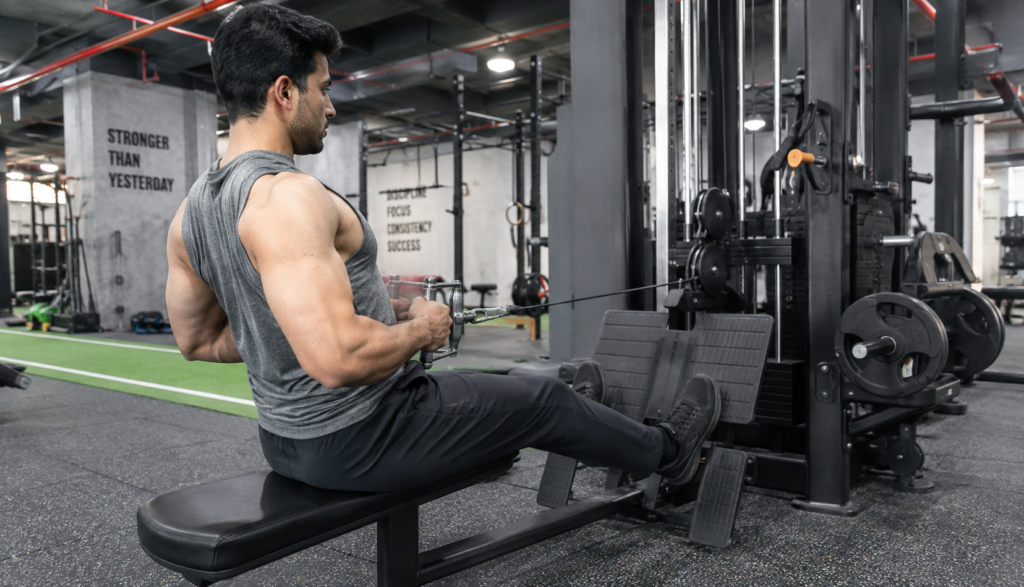
Bodybuilding programming centers on hypertrophy, which responds best to moderate reps (roughly 8–15), moderate-to-high volume, and enough total training stress per muscle group across the week. Training is usually split by body part or movement pattern — push/pull/legs, upper/lower, or individual muscle group days — so every muscle gets direct, targeted attention.
Exercise selection is much broader in bodybuilding because the goal is complete muscular development, not performance on three specific lifts. A bodybuilder might do six or more distinct exercises just for the back in a week, hitting different angles and rep ranges to maximize growth across the whole muscle group.
Physique Outcomes: What Each Sport Actually Builds
Because the training stimulus is different, the resulting physiques tend to look different too, even between athletes of similar experience level.
- Powerlifters often carry more overall mass, including a higher percentage of body fat during off-season training, since the priority is moving heavy weight, not staying lean. Muscle development tends to be dense and functional rather than deliberately sculpted for symmetry.
- Bodybuilders train and diet specifically to reveal muscle definition, which means much lower body fat levels, especially close to competition. Muscle groups are trained individually to build visible separation and proportion rather than raw force output.
Neither approach is “better” — they’re optimized for completely different outcomes. A powerlifter’s physique is a byproduct of getting strong. A bodybuilder’s physique is the entire goal.
Body composition tools can be useful for either athlete, but the way they’re used differs. A powerlifter might check a lean body mass calculator occasionally just to track long-term trends, while a bodybuilder is far more likely to monitor body fat percentage closely and consistently as part of contest prep, since small changes in leanness directly affect how they’re judged on stage.
Diet and Body Composition Differences
Powerlifters eat primarily to support performance and to make weight for their competition class. That often means eating in a slight surplus or at maintenance for extended periods, since extra body fat isn’t a scoring penalty the way it is in bodybuilding. Some powerlifters do track body composition to stay within a weight class using tools like a body fat percentage calculator, but leanness itself isn’t the goal.
Bodybuilders diet in structured phases — a bulking phase to build muscle, followed by a cutting phase to strip body fat before competition. Precision matters here in a way it doesn’t for powerlifting, since every visible pound of fat affects judging. Many bodybuilders track intake closely using a TDEE calculator or macro tracking to hit specific body composition targets on a set timeline.
Which One Should You Choose?
The right choice depends on what you actually want out of training.
Powerlifting Might Fit You If:
- You’re motivated by numbers — hitting a new personal record on your squat, bench, or deadlift
- You enjoy low-rep, high-intensity training sessions
- You want a simple, measurable way to track progress over time
- You’re not concerned with how lean you stay year-round
Bodybuilding Might Fit You If:
- You’re motivated by how your physique looks, not just what you can lift
- You enjoy higher-volume training and targeting muscles directly
- You’re willing to diet precisely, including regular cutting phases
- You want balanced, symmetrical muscle development across your whole body
Plenty of lifters also blend the two — building a strength base with powerlifting-style training, then shifting to a bodybuilding approach for a season to add size and definition. There’s no rule that says you have to pick one permanently.
Can You Do Both at the Same Time?
To a degree, yes, especially early in a training career when almost any structured resistance training builds both strength and muscle. This is sometimes called “powerbuilding” — a hybrid approach that keeps heavy compound lifts as the foundation while adding bodybuilding-style accessory volume for muscle growth.
The tradeoff shows up as you get more advanced. Peak strength and peak hypertrophy require increasingly specific programming, and pushing hard on both goals at once usually means progress on each is slower than it would be with a focused approach. Beginners and intermediates have more room to chase both; advanced lifters typically have to prioritize one.
A common approach is to run a powerbuilding-style program for most of the year, then shift into a short, focused block — either a strength peak ahead of a powerlifting meet or a cutting phase ahead of a bodybuilding show — when a specific goal is close. This lets a lifter get the general benefits of both styles without trying to peak for two very different outcomes at the same time.
The Bottom Line
Powerlifting and bodybuilding both build real strength, but they’re built around opposite priorities. Powerlifting is a performance sport judged on maximal weight lifted across three specific movements. Bodybuilding is a physique sport judged on muscle size, symmetry, and conditioning. Your training, rep ranges, exercise selection, and diet will all look different depending on which goal you’re chasing — so the best starting point is picking the outcome you actually want, then building your program around it.