
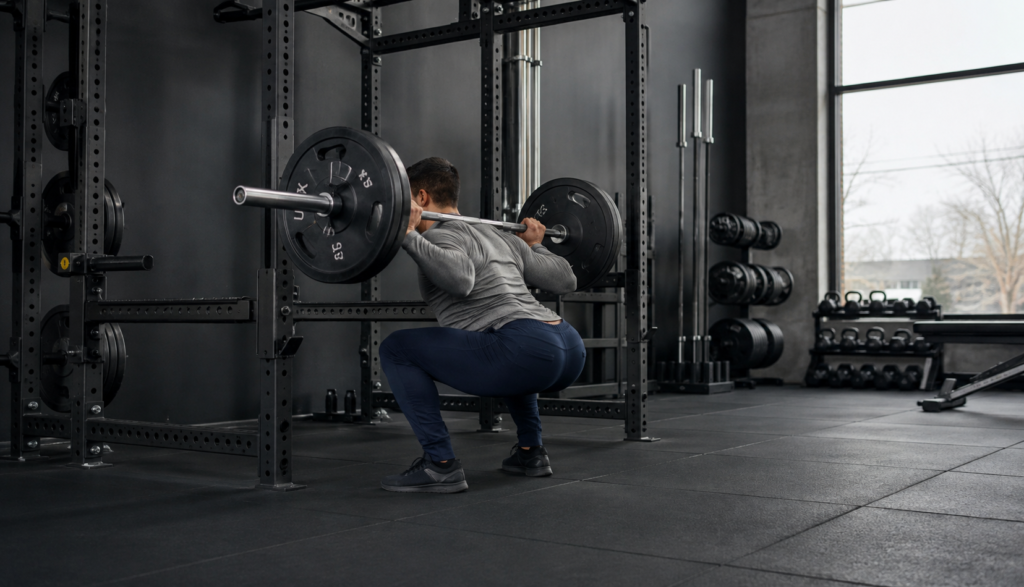
Most effective workouts fall somewhere between 45 and 75 minutes. That range covers a proper warmup, your main lifts, accessory work, and enough rest between sets to actually perform well. Go much shorter and you’re likely cutting corners on rest or volume. Go much longer and you’re probably resting too long, adding filler exercises, or pushing past the point where your effort per set starts dropping off.
But that range is a starting point, not a rule. The right workout length depends on what you’re training for, how your program is structured, and how much time you actually have to train consistently. A powerlifter chasing a heavier squat needs longer rest periods than someone doing high-rep hypertrophy work, which changes total session time even if the number of exercises is identical.
Why Workout Length Isn’t One-Size-Fits-All
Session length is really just a byproduct of three things: how many sets you do, how long you rest between them, and how much time you spend warming up and transitioning between exercises. Change any one of those and your total time changes, even if your program on paper looks the same.
This is why comparing your workout time to someone else’s rarely tells you much. A lifter doing five sets of five on squats with three-minute rest periods will spend far longer under the bar than someone doing three sets of twelve with sixty-second rests, even though both are legitimate approaches. Session length should follow from your training goal and program design, not the other way around.
Ideal Workout Length by Training Goal

Strength Training
Strength-focused sessions built around heavy compound lifts typically run 60 to 90 minutes. Building maximal strength means training with heavier loads at lower reps, which requires longer rest periods, often two to five minutes between sets on your primary lifts, to allow near-full recovery before the next attempt. Skimping on rest here doesn’t save meaningful time; it just means every subsequent set is performed under more fatigue, cutting into the very strength adaptations you’re training for.
A typical strength session includes a 10 to 15 minute warmup, one or two primary compound lifts with generous rest between sets, and two or three accessory movements with shorter rest. That structure naturally lands in the 60 to 90 minute window for most lifters.
Muscle Growth (Hypertrophy)
Hypertrophy-focused workouts generally run 45 to 60 minutes. Building muscle relies more on total training volume and time under tension than on lifting maximal loads, which means shorter rest periods, usually 60 to 90 seconds for most exercises, work well without compromising the quality of your sets. This shorter rest is a major reason hypertrophy sessions can fit more exercises into less total time than a comparable strength session.
A well-structured hypertrophy workout might include a brief warmup, four to six exercises targeting a muscle group or movement pattern, and three to four sets per exercise. Done efficiently, that fits comfortably inside an hour.
Fat Loss and Conditioning
Workouts built around fat loss or general conditioning often run 30 to 60 minutes, depending on whether resistance training, cardio, or both are included. Circuit-style training and supersets can shorten total session time significantly by minimizing rest, since you move from exercise to exercise with little downtime. This approach trades some of the load and precision of a pure strength session for a higher overall work rate in less time.
If fat loss is the main goal, workout length matters less than weekly consistency and your overall calorie balance. A shorter, more frequent training schedule often beats occasional long sessions for sustainability.
General Fitness and Maintenance
For lifters simply trying to stay active and maintain strength and muscle, 30 to 45 minute sessions done consistently are enough to maintain most of what you’ve built, especially if training frequency stays steady. This is a useful target during busy periods when longer sessions aren’t realistic, since maintaining strength requires far less volume than building it.
What Actually Determines Workout Length
Number of Exercises and Sets
More exercises and more sets per exercise directly add time. A session with six exercises at four sets each will always take longer than one with four exercises at three sets each, assuming similar rest periods. When time is limited, trimming total sets or exercises is usually more effective than rushing through rest periods.
Rest Between Sets
Rest period length is one of the biggest, and most overlooked, drivers of total workout time. Heavy compound lifts for strength typically call for two to five minutes of rest to allow adequate recovery of the nervous system, while lighter, higher-rep hypertrophy work performs well with one to two minutes of rest. Cutting rest short on heavy strength work doesn’t shorten your workout in any meaningful way; it just reduces the quality of your later sets.
Warmup and Cooldown
A proper warmup, including light cardio, dynamic stretching, and warmup sets building up to your working weight, typically takes 10 to 15 minutes. Skipping this to save time increases injury risk and often means your first working sets aren’t performed at full capacity anyway, since your body hasn’t adequately prepared for load.
Training Split and Frequency
How you divide your training across the week changes how long each individual session needs to be. A full-body routine trained three times a week packs more total work into each session, often pushing sessions toward 60 to 75 minutes, while an upper/lower or push/pull/legs split trained more frequently can keep individual sessions shorter since each one targets fewer muscle groups.
Signs Your Workouts Are Running Too Long
Workout length becomes a problem when it stops reflecting productive work and starts reflecting inefficiency or excessive volume. A few signs your sessions have drifted too long:
- Your last few sets of the session are noticeably weaker than expected for your program
- You’re resting far longer than your program calls for, often from checking your phone or losing focus between sets
- You’re adding extra exercises beyond your program because you feel like you “should” do more
- You feel drained rather than energized after most sessions
- Your sessions are creeping past two hours regularly without a clear programming reason
Sessions that consistently run past 90 minutes for most training goals are often a sign of excessive rest, too much accessory volume, or a lack of focus rather than necessary extra work. Longer isn’t inherently better once you’ve covered the volume your program calls for; extra time in the gym past that point tends to add fatigue without adding results.
Signs Your Workouts Are Too Short
On the other end, workouts that are too short usually mean not enough total volume or rushed rest periods to hit your training goal. Watch for:
- Rest periods so short your strength visibly drops from set to set on heavy lifts
- Skipping a proper warmup to save time
- Consistently doing only one or two working sets per exercise when your program or goal calls for more
- Rushing through your main lifts to leave time for less important accessory work
If your sessions are consistently under 30 minutes and you’re training for strength or muscle growth specifically, it’s worth checking whether you’re cutting rest periods or total volume short to fit the time constraint, rather than the time constraint being a natural result of your program.
Quality Over Time in the Gym
Total time spent training matters far less than what happens during that time. Two lifters can spend the same 60 minutes in the gym and get very different results depending on how close to failure their working sets are, how well they manage rest periods, and how well their exercise selection matches their goal. Chasing a specific number of minutes in the gym, rather than the quality and structure of the work itself, is one of the more common reasons progress stalls despite consistent training.
If you’re unsure whether your current training volume and calorie intake are aligned with your goal, a TDEE calculator can help you set an accurate baseline before adjusting your training time or intensity.
Building a Workout Length That Fits Your Schedule
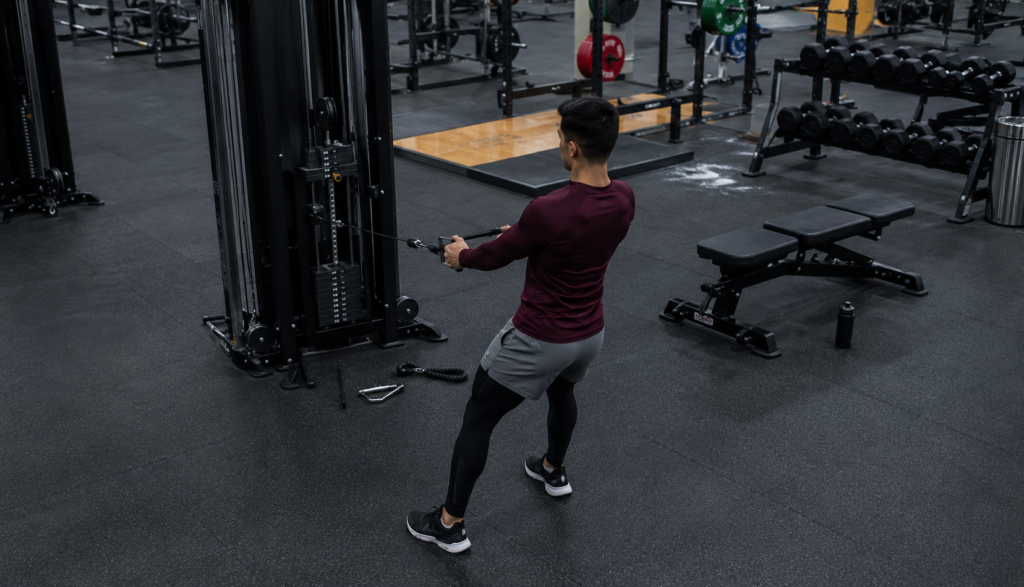
If your available time is genuinely limited, it’s better to shorten your program deliberately, fewer total exercises, tighter but appropriate rest periods, than to keep your full program and rush through it. A well-structured 45-minute session done consistently will outperform an inconsistent 90-minute session most weeks, since consistency over time drives far more long-term progress than any single session’s length.
Start by identifying your primary goal, strength, hypertrophy, fat loss, or maintenance, then build session length around the rest periods and volume that goal actually requires, rather than picking an arbitrary number of minutes and fitting your training into it.